The Entanglement of Art and Neuroscience
With the current focus on algorithms and data, art and neuroscience are becoming increasingly entangled. An example is Octopus Brainstorming, a collaborative art-science project by Researcher Victoria Vesna and Neuroscientist Mark Cohen, where two participants wear octopus-shaped EEG head pieces while their brainwaves are visualized through shifting lights and sound (Albu). This mixed-media installation is a metaphor for a deeper connection – communication beyond language, beyond species.

Fig. 1. Victoria Vesna, Mark S. Cohen, Octopus Brainstorming, Art|Sci Collective, 2016, Luskin Conference Center at UCLA. Courtesy of Patricia Olynyk and Victoria Vesna. https://www.sfu.ca/content/sfu/cmajournal/issues/issue-ten--enchantment--disenchantment--reenchantment/cristina-albu/jcr:content/main_content/image.img.1280.high.jpg/1628111456947.jpeg
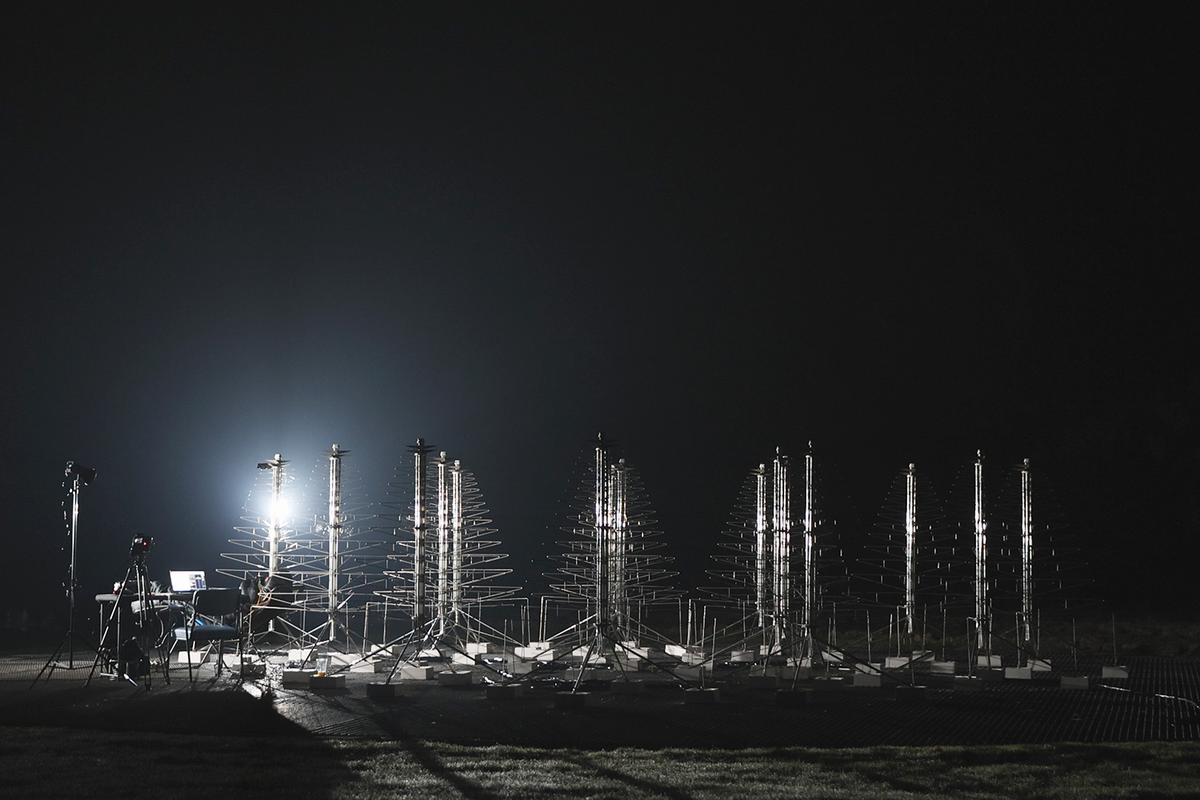
This vision resonates with other projects that explore how mind and matter may intersect. The Global Consciousness Project, for example, uses random event generators (REDs) to detect subtle correlations between human consciousness and global events (GLOBAL CONSCIOUS). Also, Artistis across the globe are also visualizing brain data. The winner of the 2022 Art of Neuroscience, Mare Incognito, transmitted sleeping brainwaves into space, connecting personal consciousness with the universe (Samuels and Tormes)

Fig. 2. Mirjam Somers and Bas Czerwinski, Still image from the performance film Mare Incognito, Scientific American, https://static.scientificamerican.com/sciam/assets/Image/2022/SII/Img1.png?w=1200
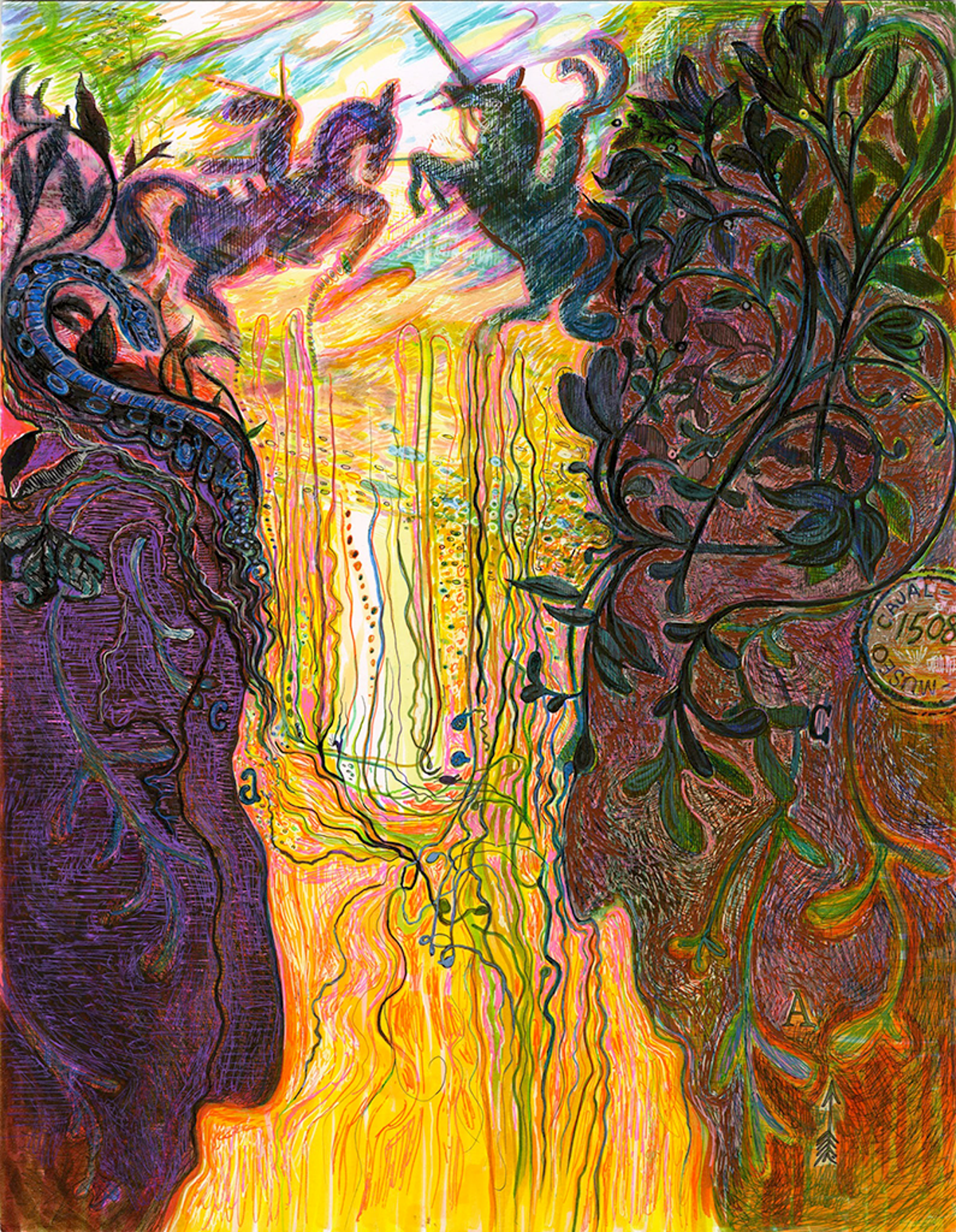
MIT’s Vision in Art and Neuroscience course reflects the inverse, how art can influence neuro-processes, and it does this by asking how perception itself can be experienced as a creative act. Installations at MIT encourage viewers to feel their perceptual processes at work – the act of viewing artwork becomes an artwork itself (Blaszczyk).

Fig. 3. Dawn M. Hunter, Dueling Cajals, Scientific American, https://static.scientificamerican.com/sciam/assets/Image/2022/SII/IMG2.png?w=1200
All of these projects rethink what it means to be conscious, and these artworks don’t “solve” the mysteries of the brain, but instead, invite us to feel and participate. This allows for a deeper interconnectedness with each other, as well as the nonhuman world, creating a “neoculture” where science, art, and philosophy intertwine (Frazzetto and Anker). As I always think after every week, I never thought about this intersection before, but there is so much cool work within art that uses neuroscience and vice versa!
Works Cited
Albu, Crisitina. “Cristina Albu.” Www.sfu.ca, www.sfu.ca/cmajournal/issues/issue-ten--enchantment--disenchantment--reenchantment/cristina-albu.html?fbclid=IwAR1twyrqbeKqNrJSUXSihLVGvX_D9ARndxDv3USnw2pTENE_iXHJtIo8v54.
Blaszczyk, Connie. “3Q: The Interface between Art and Neuroscience.” MIT News | Massachusetts Institute of Technology, 16 Apr. 2019, news.mit.edu/2019/3-questions-sarah-schwettmann-interface-between-art-and-neuroscience-0416.
Frazzetto, Giovanni, and Suzanne Anker. “Neuroculture.” Nature Reviews Neuroscience, vol. 10, no. 11, Nov. 2009, pp. 815–21, https://doi.org/10.1038/nrn2736. Accessed 30 May 2022.
“Global Consciousness Project: Introduction.” Noosphere.princeton.edu, noosphere.princeton.edu/gcpintro.html.
Tormes, Fionna M. D. Samuels,Liz. “See the Top Entries in the Art of Neuroscience Competition.” Scientific American, Aug. 2022, www.scientificamerican.com/article/see-the-top-entries-in-the-art-of-neuroscience-competition1/.


Hi Kylie, I enjoyed reading your blog. I really liked the integration of neuroscience and art that Vesna and Cohen's project showed. I wrote about how neuroscience, or science in general, is seen in a more serious tone rather than for its beauty. This week's lectures have taught me to look at neuroscience from another perspective after years of studying it from one perspective as a psychology major. Their project shows the neuroscience behind the beautiful connection between two humans. It allows neuroscience to be seen in another light, where it shows the emotional and artistic approach of it, finding its true beauty. I like how you worded it: these projects make you feel, which I think is one of the most beautiful things in life, and such a blessing to be able to feel. Thank you for sharing. Keep up the good work.
ReplyDeleteThis blog really opened my eyes to the surprising ways art and neuroscience can connect. The Octopus Brainstorming project stood out to me—it's amazing how brainwaves can be transformed into a visual and emotional experience that explores communication beyond language. I also made my blog about this project because it really stuck with me and made me think differently about how we experience connection. Mare Incognito was fascinating too; sending brain activity into space turns something deeply personal into something universal. The section about MIT’s installations was thought-provoking—seeing perception as a creative act makes the viewer an active part of the artwork. Your conclusion about “neoculture” was powerful—it’s exciting to think about how art, science, and philosophy can come together to help us better understand consciousness and connection. Great job—keep up the amazing work!
ReplyDeleteHi Kylie, I really enjoyed reading your post! The Octopus Brainstorming piece is so surreal and symbolic, like using brainwaves to communicate beyond language is something out of sci-fi but totally grounded in real science. I was especially intrigued by the Global Consciousness Project too—if human consciousness can actually affect random data, that really challenges how we think about collective energy and intention. The Mare Incognitivo sending brain waves to space is also interesting. That’s such a beautiful way to link personal experience with something cosmic. I also love how MIT’s installations flip the experience back on the viewer, making perception itself part of the art. It’s so cool to see how this “neuroculture” is blending science and creativity in ways that don’t give us all the answers, but invite us to feel, reflect, and connect more deeply.
ReplyDelete